About
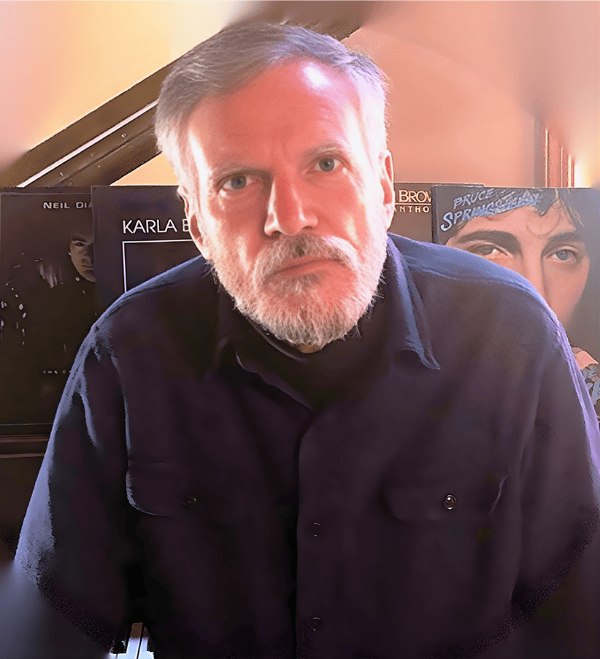
Peter Sarno was raised in Revere, Massachusetts, and earned a Master of Arts from the University of Massachusetts Boston. While a graduate student at UMass, Sarno won the Donald E. Cookson prize in non-fiction.
Sarno taught computer courses at Northern Essex Community College and literature and memoir courses at the University of Massachusetts Boston. His work has appeared in The Boston Globe, Music World, Sweet Potato, Gannett newspapers, GateHouse Media, and other outlets.
His novel Visions of Johanna was published in 2022. It was named one of the "Best Reviewed Books of September" by IndieReader and one of the "20 Favorites From 2022 That You’ve Probably Never Heard of But Should Have" by BookTrib. In a starred review, Booklist wrote, "Sarno’s beautifully written literary novel concerns an unlikely pairing . . .The author skillfully portrays Matt, drawing readers into the story with his use of metaphor and lush language. . . .As the story reaches its affecting conclusion, readers may even shed a tear or two."
Sarno released his novel, A River of Memory, in the summer of 2026. He lives in Rockport, Maine, with his wife, Nanette.
Q & A
When did you first decide to become an author?
Perhaps earlier, but in the 6th grade, Sister Mary Ellen (who played touch football with us in the schoolyard during recess) encouraged us to write a story in the vein of Stockton’s “The Lady or the Tiger,” and I remember her liking mine and encouraging me.
What’s a great piece of advice that you can share with fellow writers?
I’m not sure I can distill these recommendations down to one thing. I’ve read dozens of books and magazine articles on craft, and I’m sure at least some aspect of each and every one of them has proven helpful. Still, I don’t think they top what novelist and short story writer Ivan Gold told a handful of us green BU students when I went back to grad school (the first of a couple of times) in the early ’80s, “Stay away from negative people.”
If I had heeded his advice, I think I might have moved that much further along, much more quickly.
It’s important for authors to carve out their own territory, to create their own protective bunkers, and part of the armor necessary is keeping the negative folks away—well-meaning friends and foes alike. I don’t want to imply that an aspiring author should become Pollyannaish about it. Honest, sincere criticism as well as competent professional editors are mandatory. But there are too many people willing to advise creative types to simply give up.
The other thing I discovered is that pain is important. Not “woe is me doesn’t my life (or my character’s life) suck” pain, but there remains a need to pursue it in your art—no matter how vulnerable that ultimately might make you feel.
Is there something in particular that motivates you (fame? fortune?)
In a perfect world, I’d love to be able to garner empathetic readers one at a time. Those who might say, Gee, I know how that character feels, or why a person acted a certain way. Hopefully, I’ll be able to entertain that person and help them feel something during our shared journey. Asking someone to invest several hours of their time in your book is not an insignificant request. I understand this commitment and remain grateful and honored when a person is willing to take that tremendous leap of faith.
Which writer, living or dead, do you most admire?
This is a tough—if not an impossible—question to answer. So, I’ll cheat and name two—one living and one dead—and then come to regret I hadn’t mentioned dozens of others.
Ann Beattie, because she accurately tapped into the isolation and the disconnect I—and many others—felt in the ’70s. And Andre Dubus Jr., because of the pathos he was able to express in his short stories and novellas—long before the tragedies that eventually encompassed his own life.
Which book do you wish you could have written?
Another very difficult choice. This pick changes at least several times per week. So, for today, I’ll say Nobody’s Fool by Richard Russo. There are no car chases, no murders. It’s simply a slice-of-life tale of working-class people who sometimes act heroically, mostly accept each other’s frailties, and usually try to face each new day with courage, resolve, and humor.
What authors do you read when you aren’t writing?
A tough question to ask of a former lit professor (smile). There are dozens. Fitzgerald, Ann Beattie, Andre Dubus, Jr., Ann Patchett, Roland Merullo, Richard Russo, Anne Tyler, Billie Letts, Susan Cheever, Maya Angelou, Denise Duhamel, Susanna Kaysen, Joe Torra, Marge Piercy, Alice Munro—and, early on, the Russians, Camus, Ibsen, Dick Gregory, John Cheever, Eugene O'Neill . . .
Tell us about your writing process.
I know (and respect) authors who outline and use whiteboard techniques, etc., and they usually complete their manuscripts much more quickly than I do. But, for better or worse, I seem to have to accompany the characters along their sometimes-arduous journeys. I may have some general idea how one of my short stories or novels will end—but not a definitive one. To know exactly where I was—or my characters were—headed would deaden the experience for me, taking the fun out of discovery. And, I rely on my editors and early readers to point out what isn't working and to ask me questions.
The problem with this process, of course, is that it takes me a great deal longer to complete a work. And, at my age, that's not a good thing (laughs).
What other advice would you give to aspiring authors?
Find and hire a good and trustworthy editor. Read a lot of stuff—at least in your genre of choice. Don't feel guilty when those other folks tell you that you MUST write every day. How can most of us accomplish that? And I think this type of direction discourages aspiring authors and gives them one more reason to give up. Find the time that you can to write and try to keep it sacred—no matter how limited it is. Other authors don't know your lifestyle, your responsibilities, or what's on your shoulders. The hell with them. Do the best you can with the time you have.
Don't listen to the naysayers—or what my friend Roland Merullo calls the "demons" inside ourselves who will do anything to convince us we're not worthy.
There's a story inside you, I believe in you, get to it.